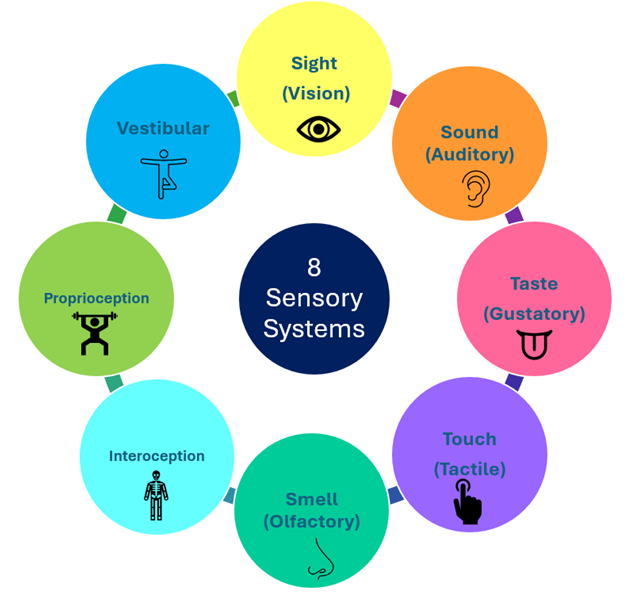
Often a sensory assessment is requested by families or support teams to understand how a person’s patterns of sensory registration and modulation impact (their sensory profile) impact a person’s ability to engage in daily life.
Sensory registration impacts how the brain receives sensory data and is able to integrate and process the data to create cognitive meaning.
Modulation patterns refers to patterns of seeking, avoiding or sensitive patterns of behaviours in order to manage their thresholds for processing and maintaining a steady state of arousal.
In a sensory assessment the clinician will:
Complete formal sensory assessments using the sensory profile or sensory processing measure.
Complete an informal sensory assessment where the clinician observes the client’s sensory registration and modulation patterns. This is a very important step to ensure accuracy in understanding a person’s sensory profile as often formal measures may demonstrate mixed profiles due to maladaptive and adaptive behaviours a person recruits to cope or manage sensory challenges. Our clinician’s are highly trained in informal assessment techniques to test neurophysiological and cognitive integration patterns to understand a person’s true sensory profile.
Discuss sensory patterns and behaviours with the caregiver.
The outcomes are then documented in a report with the profile of the person being explained to ensure the parent, caregiver, teacher ect. understand the profile, impact and strategies of support which would be useful.